
AI Adoption in Healthcare Foodservice: Key Takeaways from the AHF Coffee Talk
Artificial intelligence is no longer a future concept for healthcare foodservice—it’s becoming a practical tool for helping operators find better ways to use time, talent, and resources today.
Artificial intelligence continues to dominate conversations across healthcare, but what does meaningful AI adoption actually look like inside a hospital foodservice operation?
That was the focus of a recent AHF Coffee Talk sponsored by Computrition, featuring Kevin Steffes, Director of Food & Nutrition Services at Carle Health, alongside Computrition Senior Account Relationship Managers Holly Illions and Erick Hankinson.
Rather than discussing AI as a future concept, the panel explored practical ways healthcare foodservice leaders are already using AI to improve operations, support staff, and enhance the patient experience.
One theme surfaced repeatedly throughout the discussion:
Successful AI adoption isn’t about replacing people—it’s about giving them more time to focus on the work that matters most.
Why Healthcare Foodservice Leaders Are Exploring AI
Healthcare foodservice departments continue to face familiar challenges:
- Staffing shortages
- Growing operational demands
- Increased reporting requirements
- Pressure to improve efficiency without sacrificing quality
As Kevin Steffes explained during the webinar:
“Every day we’re being asked to do more with less.”
Rather than viewing AI as a workforce replacement, the discussion focused on using it to eliminate repetitive administrative work so leaders can dedicate more time to coaching staff, improving service, and making operational decisions.
How AI Can Optimize Diet Office Staffing
Perhaps the most compelling example shared during the Coffee Talk came from Carle Health’s diet office.
Like many healthcare organizations, the department receives extensive call-center reports. Instead of manually analyzing the year-to-date call volume information, Kevin used AI to:
- Examine large Excel datasets
- Aggregate call volumes into 30-minute intervals
- Analyze answered versus queued calls
- Recommend optimized staffing schedules
- Factor in hours of operation, shift lengths, and employee breaks
What traditionally could have required hours of spreadsheet analysis was completed in approximately 45 minutes.
The outcome wasn’t simply faster reporting—it produced actionable insights that helped identify optimal staffing levels that could be presented to senior leadership with confidence.
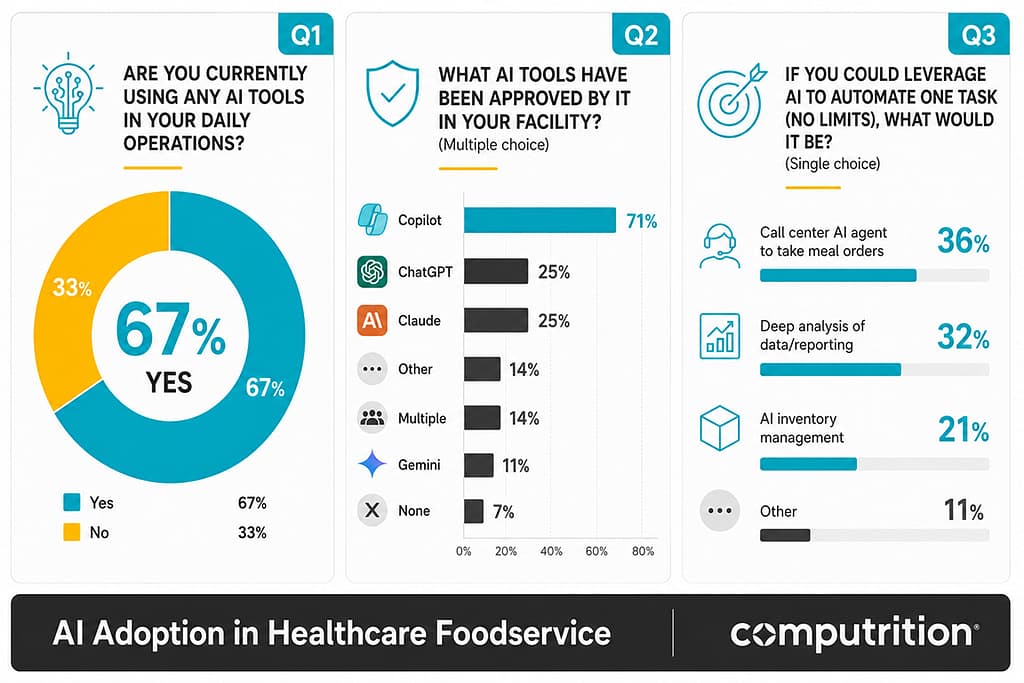
AI Should Repurpose Work—Not Replace People
One of the webinar’s strongest messages challenged a common concern about artificial intelligence: its purpose is to support employees to work more effectively.
Rather than replacing people, AI provides an opportunity to:
- Reduce repetitive manual work
- Improve labor utilization
- Enable leaders to focus on higher-value responsibilities
This perspective resonated throughout the discussion and reflects how many healthcare organizations are approaching AI adoption today.
Responsible AI Matters in Healthcare
Healthcare requires a different level of caution than many other industries.
Throughout the discussion, the panel emphasized several best practices for responsible AI implementation:
Protect sensitive information
Organizations should avoid entering protected health information (PHI) into public AI platforms unless approved by IT and compliant with organizational policies.
Partner with IT early
Many hospitals now have formal technology assessment committees that evaluate AI solutions for:
- Security
- Compliance
- Data governance
- Vendor risk
- Clinical value
Validate AI-generated results
AI should assist decision-making—not replace human judgment.
Leaders should always review outputs for accuracy before acting on recommendations.
Practical AI Use Cases Healthcare Foodservice Teams Can Start Using Today
One of the webinar’s most valuable discussions focused on realistic ways leaders can begin using AI immediately.
Examples included:
Writing and communication
AI can help draft emails, announcements, policies, and documentation while allowing users to personalize the final message.
Data analysis
Large reports can be summarized quickly to identify trends, staffing opportunities, or operational improvements.
Retail planning
Create and refine promotional initiatives to drive engagement in retail operations:
- Limited-time offer planning
- Seasonal promotions
- Marketing ideas
- Menu brainstorming
Training materials
Departments can use AI to create onboarding guides, reference materials, and educational content more efficiently.
Inventory insights
Identify slow-moving inventory and recommend promotional opportunities before products become waste.
Frequently Asked Questions About AI in Healthcare Foodservice
How is AI being used in healthcare foodservice today?
Healthcare organizations are using AI to analyze operational data, assist with documentation, improve scheduling, support retail planning, develop training materials, and streamline administrative tasks.
Will AI replace healthcare foodservice staff?
The webinar emphasized that AI should enhance employee productivity by automating repetitive work, allowing staff to focus on patient care, leadership, and operational decision-making.
Is AI safe to use in hospitals?
When implemented responsibly and in partnership with IT, AI can provide significant operational value. Organizations should involve IT teams, protect sensitive data, follow governance policies, and validate AI-generated outputs before acting on recommendations.
What’s the best way to get started with AI?
Start with low-risk administrative tasks such as writing communications, summarizing reports, analyzing operational data, or creating educational materials. Build familiarity before expanding into more advanced applications.
Practical AI Starts with Purpose
Artificial intelligence is no longer a future concept for healthcare foodservice—it’s becoming a practical tool for helping operators find better ways to use time, talent, and resources today.
The AHF Coffee Talk demonstrated that successful AI adoption isn’t measured by how much work technology performs. Instead, it’s measured by how effectively it helps healthcare professionals spend more time where they’re needed most: supporting patients, leading teams, and making informed decisions.
As healthcare foodservice departments continue balancing staffing challenges, operational efficiency, and patient satisfaction, thoughtful AI adoption offers an opportunity to work smarter while keeping people—not technology—at the center of care.
Related Posts



Ready to experience our software?
Get a Taste of our Foodservice Software!